Post
Obsidian Throne Mint: A Complete Collector’s Guide #9
Jun
The Origin Story of the Obsidian Throne Mint
The Shadow Empire did not emerge from darkness out of malice or defeat. It emerged from a philosophical critique. Its founders were scholars and natural philosophers who had spent decades studying why great civilizations failed, and their conclusion was consistent and uncomfortable: civilizations that organized themselves around light, glory, and visible achievement inevitably built on foundations of illusion, because what is visible is also what is falsifiable, what is praised is also what is performed rather than genuinely practiced, and what shines attracts the envy that destroys.
The Shadow Empire’s founding document argued instead for organizing society around depth, substance, and what it called the productive clarity of shadow — the ability to see clearly what direct light obscures through glare and surface reflection. The Obsidian Throne Mint was the monetary expression of this philosophy, produced from volcanic black glass fused with silver veins, dark as the productive shadows the empire celebrated, with inner luminosity visible only at the right angle to those who knew how to look. It was a coin that rewarded understanding over mere observation, a currency that distinguished its bearers from those who only saw what the light showed them.
Historical Significance in Fantasy Empire Currency
The Obsidian Throne Mint’s significance in the fantasy empire currency tradition is dual. As a monetary instrument, it performed admirably within the Shadow Empire’s trade zone, its unusual composition providing natural counterfeit resistance and its consistent quality maintaining commercial trust. But its more enduring significance is philosophical and aesthetic: the Obsidian Throne Mint is the only coin in the ancient numismatic record that was deliberately designed to be more impressive to thoughtful observers than to casual ones, more beautiful to those who took time to examine it than to those who merely glanced.
This design philosophy, applied to a monetary instrument, is extraordinary because coins are normally designed for maximum immediate impact — they are assessed in fractions of seconds by merchants who handle hundreds in a day and must reach instant conclusions about value. The Shadow Empire chose to make a coin that rewarded patience and attention, accepting slower commercial processing in exchange for a coin that embodied its civilization’s core values at every interaction. This was not a commercial mistake but a philosophical statement: the Shadow Empire was not optimized for the impatient.
Design and Craftsmanship
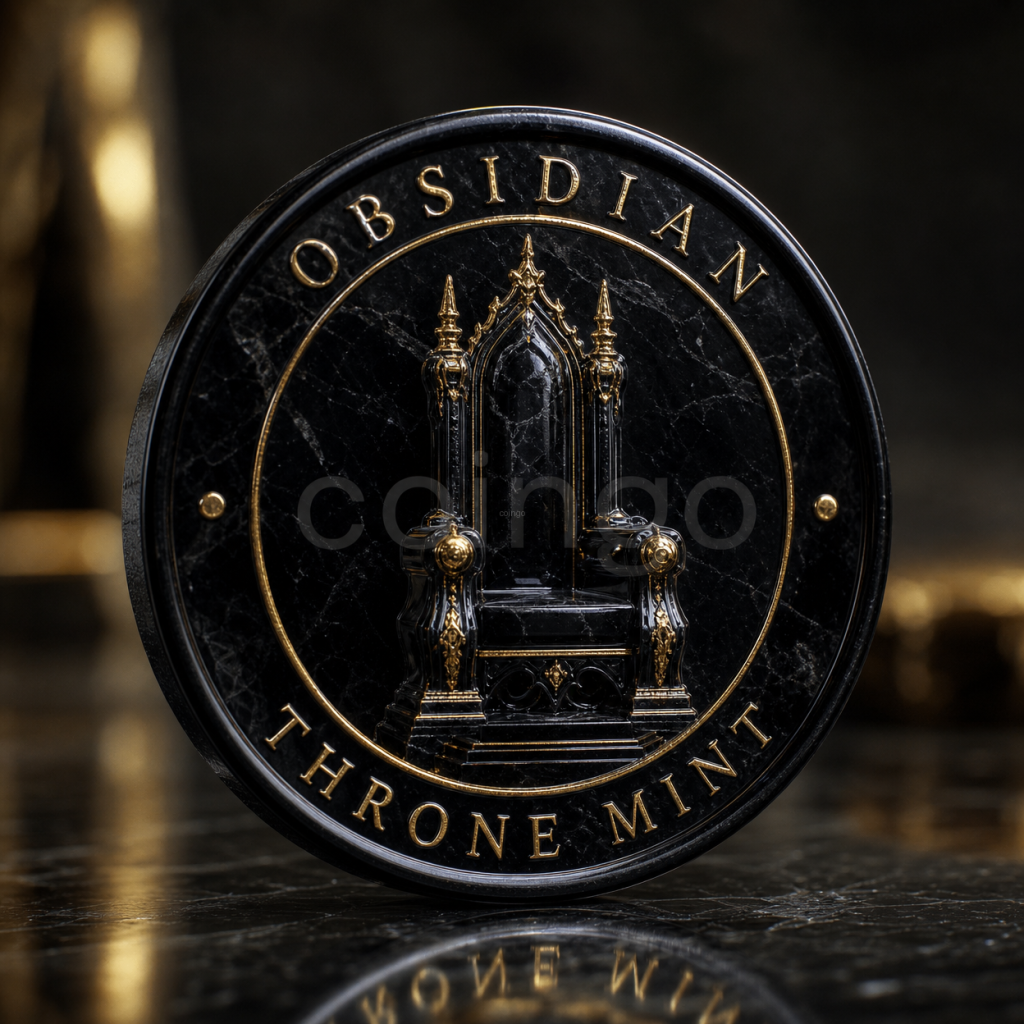
The obverse of the Obsidian Throne Mint presents the Obsidian Throne itself — carved from a single volcanic boulder by six master stonemasons over two years — occupied by the shadow-silhouette of the sitting Emperor, deliberately rendered without individuating features. The Throne is the authority; the Emperor is its temporary occupant.
This anti-personalist design philosophy, embedded in the coin’s most prominent visual element, communicates the Shadow Empire’s constitutional principle that institutions outlast individuals and that genuine power belongs to structures rather than persons.
The reverse carries the empire’s proclamation in silver lettering that shines against the black surface with dramatic contrast: “From Darkness, Order.” The black volcanic obsidian-composite surface is interrupted by silver veins that distribute light in unpredictable, ever-shifting patterns, making the coin seem to contain hidden luminosity that only appears in response to movement. Our reproduction achieves this effect using a modern obsidian-composite with embedded silver-tone inclusions that replicate the original’s characteristic silver-vein patterning with remarkable fidelity.
Rarity and Collector Value
The Obsidian Throne Mint is the single most visually dramatic coin in the fantasy empire currency collection, its absolute black surface and shifting silver veins creating a display impact unlike any other piece in numismatics. Collectors who specialize in dark fantasy aesthetics or philosophical numismatics consistently identify it as their most prized acquisition.
Our reproduction is offered in a premium illuminated display case that positions the coin under adjustable lighting to demonstrate the full range of its silver-vein display behavior — from the near-invisible uniformity of frontal direct light to the dramatic diagonal light reveals that show the veins in their most dramatic configuration. The case rotates slowly on an automated base, showing the coin’s behavior across a complete 360-degree rotation, an effect that visitors to a collection consistently find mesmerizing.
The Legend Behind the Coin
The Shadow Empire’s propaganda successfully embedded the legend of the Obsidian Throne Mint’s indestructibility throughout the ancient world, and this legend has proven remarkably durable in the centuries since the empire’s decline. The story that Shadow Empire coins could not be destroyed by hammer, acid, or fire circulated in trading post records from the empire’s second century and continues to appear in numismatic folklore today. Our own production testing of the obsidian-composite reproduction — not, we emphasize, an endorsement of attempting to destroy your coins — confirms that the material has genuinely impressive resistance to normal metal-testing procedures.
The volcanic glass component is significantly harder than conventional metals, and its fusion with the silver matrix creates a composite that resists acid etching substantially better than pure silver. The legend of indestructibility may have been politically motivated propaganda, but it had a real material basis in the composition the Shadow Empire actually developed for its currency.
The Shadow Empire’s Enduring Influence
The Shadow Empire declined over a period of approximately three generations, its philosophical sophistication unable to compensate for the practical challenges that eventually confronted all ancient states: succession crises, resource competition, and the accumulated weight of maintaining a civilization built around principles that required its citizens to think carefully about things that other civilizations allowed them to accept uncritically. The decline was gradual, the institutions maintaining their function longer than the political structures that nominally governed them, and the Obsidian Throne Mint remained in production and circulation long after the Shadow Throne itself ceased to function as an actual governing instrument.
In the centuries following the empire’s formal dissolution, its philosophical legacy persisted in academic traditions that continued to teach Threshold epistemology and depth-over-surface analysis as methodological approaches with value independent of the political context in which they had originally been developed. The Obsidian Throne Mint is the most direct surviving material expression of this intellectual tradition, the empire’s most complete philosophical statement surviving in a form that the fires and floods that destroyed its texts could not touch.
Add This Coin to Your Collection
The Obsidian Throne Mint is for collectors who want their collection to include a philosophical counterpoint — a coin that argues, in its material and its design, for the productive clarity of darkness against the blinding illusions of easy light. Its black volcanic surface, shifting silver veins, silhouetted emperor, and three-word proclamation of a complete governing philosophy make it one of the most intellectually dense objects in fantasy numismatics.
Add it to your collection and let the Shadow Empire’s central argument rest alongside your more luminous pieces: that what lies beneath the surface, visible only to those who look carefully and think deeply, is where the genuine value lives.
