Post
Moonshadow Relic Token: A Complete Strong Collector’s Guide #5
Jun
The Origin Story of the Moonshadow Relic Token
The Moonshadow Order began with an observation that its founder, an astronomer named Dreveth, found he could not explain adequately within any available philosophical framework: shadows cast by moonlight behaved differently from shadows cast by sunlight in ways that were not simply quantitative — not merely dimmer or softer — but qualitatively distinct, conveying different spatial information about the objects casting them. After twenty years of systematic observation, Dreveth concluded that moonlit shadows contained information about depth, structure, and hidden features of their casting objects that solar shadows suppressed through intensity.
He developed from this observation a complete epistemological system, the philosophy of the Threshold, arguing that the most authentic information about any subject was available not in conditions of maximum illumination but in conditions of threshold light where normal visual dominance was suspended and the deeper informational content of shadow became accessible.
The Moonshadow Relic Token was the practical application of this philosophy: an object whose engraved patterns were designed to cast maximally information-rich shadow configurations under specific moonlight conditions, functioning simultaneously as a divination tool and as a demonstration that Dreveth’s optical theory had genuine predictive and generative power.
Historical Significance in Mystic and Legendary Coins
The Moonshadow Relic Token stands as the mystic and legendary collection’s most technically sophisticated piece, its shadow-casting system representing an application of optical engineering to a divination object that has no parallel in the ancient record. Modern optical analysis of authenticated Token specimens has confirmed that the engraving depths, wall angles, and relationships between adjacent elements are precisely calibrated to produce specific shadow configurations under specific lighting conditions, the engineering not accidental or approximated but deliberately calculated.
The level of optical planning required to achieve this at coin scale, without computational tools, suggests either a mathematical sophistication beyond what we attribute to the Order’s era or an empirical refinement process of extraordinary patience and precision. Either explanation is impressive, and the Token’s existence as a designed optical instrument raises fundamental questions about the ancient world’s practical scientific capabilities that scholars continue to explore.
Design and Craftsmanship
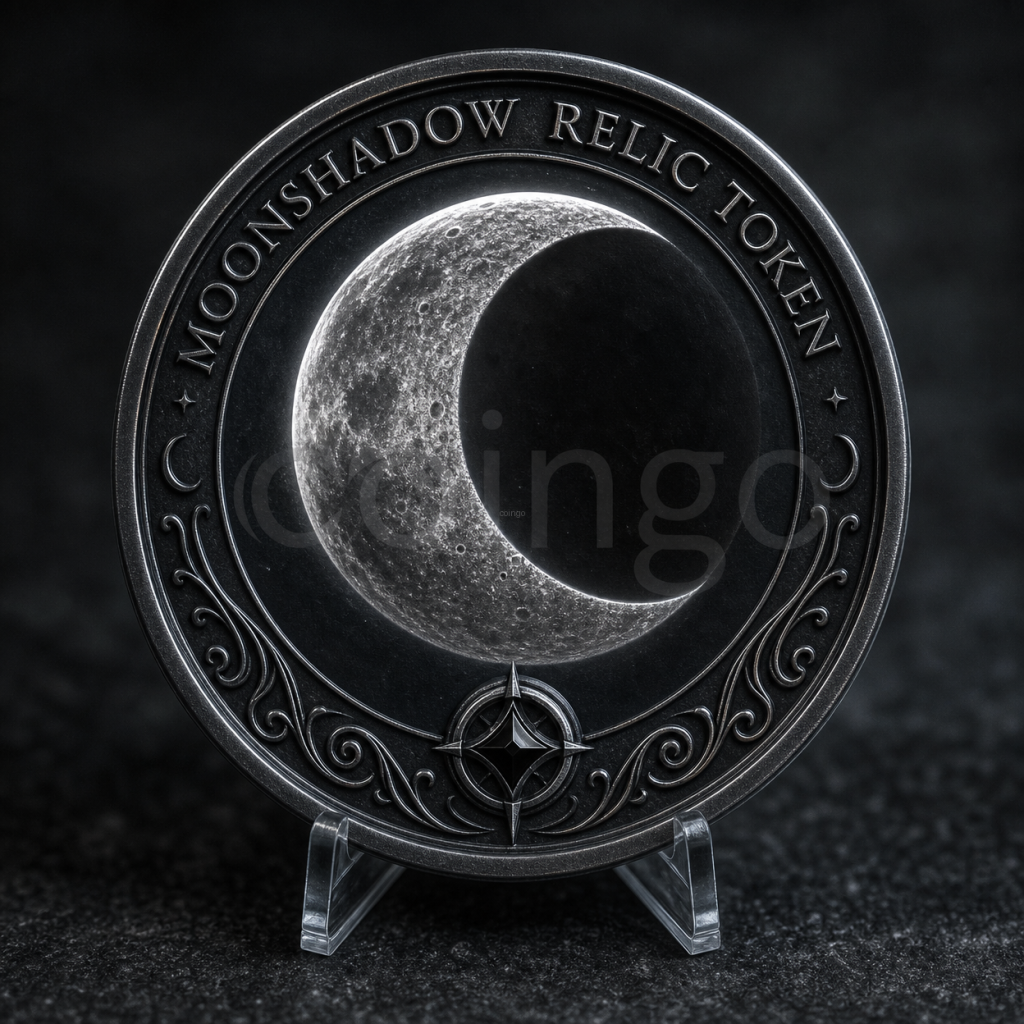
The obverse of the Moonshadow Relic Token is covered in a dense network of intersecting curves and circles that appears decorative under ordinary examination but resolves under specific lighting conditions into three distinct shadow-reading configurations, each associated with a different category of divinatory meaning in Order tradition.
The pattern’s visual complexity ensures that casual observation cannot distinguish the Token from a purely decorative object, a deliberate concealment strategy that protected its use during periods when the Order operated under official disapproval. At the center of the pattern, the Order’s all-seeing eye symbol within its twelve-pointed star occupies a position of geometric centrality, its slightly recessed polished disc pupil creating a three-dimensional focal point that shadow patterns radiate from and return to in all three reading configurations.
The reverse carries the Order’s lunar phase marker ring and the central eye symbol, the eight phase markers individually calibrated for the slight optical differences between moonlight quality at different phases that Order doctrine identified as meaningful variations in the shadow information available to trained readers.
Rarity and Collector Value
The Moonshadow Relic Token is the mystic and legendary collection’s most rewarding piece for collectors who enjoy active engagement with their acquisitions rather than passive display.
The shadow-casting system built into the engraving provides continuous new discoveries as collectors experiment with different lighting angles and intensities, the three configurations appearing and disappearing in response to changing light conditions in ways that full-spectrum studio examination consistently fails to fully catalog in advance.
We include with every Token a shadow-reading reference guide documenting the three configurations and their traditional interpretive associations, allowing collectors to use the Token as the Order’s initiates intended, as a divination object whose results depend on the specific shadows produced by the specific light available at the moment of consultation.
The Legend Behind the Coin
The most widely documented legend of the Moonshadow Relic Token concerns its behavior at the moment of the monthly new moon, when no moonlight is available for shadow casting. Order texts document a consistent tradition among senior practitioners that the Token retained, for a period of three days around the new moon, shadow information from the previous full moon — that careful examination in a darkened room with a single candle placed at the angle corresponding to the previous full moon’s illumination position would reveal shadow configurations identical to those the Token had cast under genuine full moonlight.
Whether this represents a genuine optical memory effect in the engraved material, a psychoacoustic phenomenon in highly trained observers, or pure tradition without physical basis is unknown.
The possibility that the Token retains the memory of its most recent illumination gives every handling of the coin between full moons a slightly different character from handling at full moon, and Order practitioners documented these differences extensively in records that continue to attract scholarly attention.
The Practice of Threshold Observation
The Moonshadow Order’s training methodology for developing useful threshold perception — the ability to extract genuine information from moonlit shadows rather than experiencing them as merely decorative — was documented in an internal manual partially recovered from an excavated chapter house. The training proceeded in stages over approximately three years, beginning with exercises in distinguishing shadow types and progressing through increasingly complex shadow-reading challenges until the trainee could reliably extract shadow configurations from the Relic Token at the specified lunar conditions and interpret them according to the Order’s established correspondences.
The manual’s most interesting section describes a stage in the training where students who had become competent shadow readers began reporting information from the tokens that the established correspondence tables did not cover — idiosyncratic messages specific to individual readings that went beyond the systematic interpretive framework the Order had developed. The Order’s response to this was to document these individual readings carefully rather than dismiss them, creating a supplementary archive of shadow communications that the standard tables could not account for. This archive, if it survives somewhere, may represent the richest documentation of threshold perception in the ancient record.
Add This Coin to Your Collection
The Moonshadow Relic Token is for collectors who want their collection to include a genuine optical instrument — a coin that rewards active experimentation, that changes as the light changes, and that was designed by an ancient philosopher-engineer to make a specific argument about the informational content of shadow visible to anyone patient enough to examine it under the right conditions. Order today, place it in the moonlight, and discover what Dreveth spent twenty years observing: that shadows have things to say that direct light cannot tell you.
