Post
Coralfang Sea Token: A Complete Collector’s Guide #17
Jun
The Origin Story of the Coralfang Sea Token
The Coralfang Brotherhood arose from commercial frustration rather than political conviction. Its seven founding members were legitimate coastal traders who, in the span of five years, had paid tribute to four competing maritime powers for the right to sail the same waters, watched two of their ships confiscated by officials whose authority they disputed, and spent more on harbor fees than on the cargo that justified sailing.
Their founding meeting, held on a small island where no power claimed jurisdiction, produced a simple compact: they would share their ships, their intelligence about harbor conditions and hazard locations, their repair facilities, and their emergency provisions, and they would operate a network of alternative harbors where none of the competing powers could demand tribute.
The Coralfang Sea Token was the key to this network, a piece of physical identification that admitted its bearer to the Brotherhood’s resources, marked them as a network participant rather than a network outsider, and eventually came to carry an exchange value of its own as the Brotherhood’s operations expanded into a genuine alternative commercial system spanning hundreds of maritime communities.
Historical Significance in Pirate and Maritime Coins
The Coralfang Sea Token is the pirate and maritime collection’s most practically innovative piece, a coin whose value was almost entirely non-monetary for most of its history. Unlike other coins in the collection that functioned as commercial currency with secondary significance, the Token was primarily a network access credential whose monetary value was incidental to its function.
Maritime scholars who have studied the Brotherhood’s operational period describe it as a prototype of what modern economics calls a platform network: an organization whose value to any individual member increased as the total membership grew, because each new member added another safe harbor, another source of intelligence, another emergency resource to the network available to all. The Token was the physical representation of network membership, and the premium its bearers received in Brotherhood markets — reduced fees, priority docking, access to information networks — reflected the genuine commercial value of the platform they had joined rather than the intrinsic value of the coral-bronze object they carried.
Design and Craftsmanship
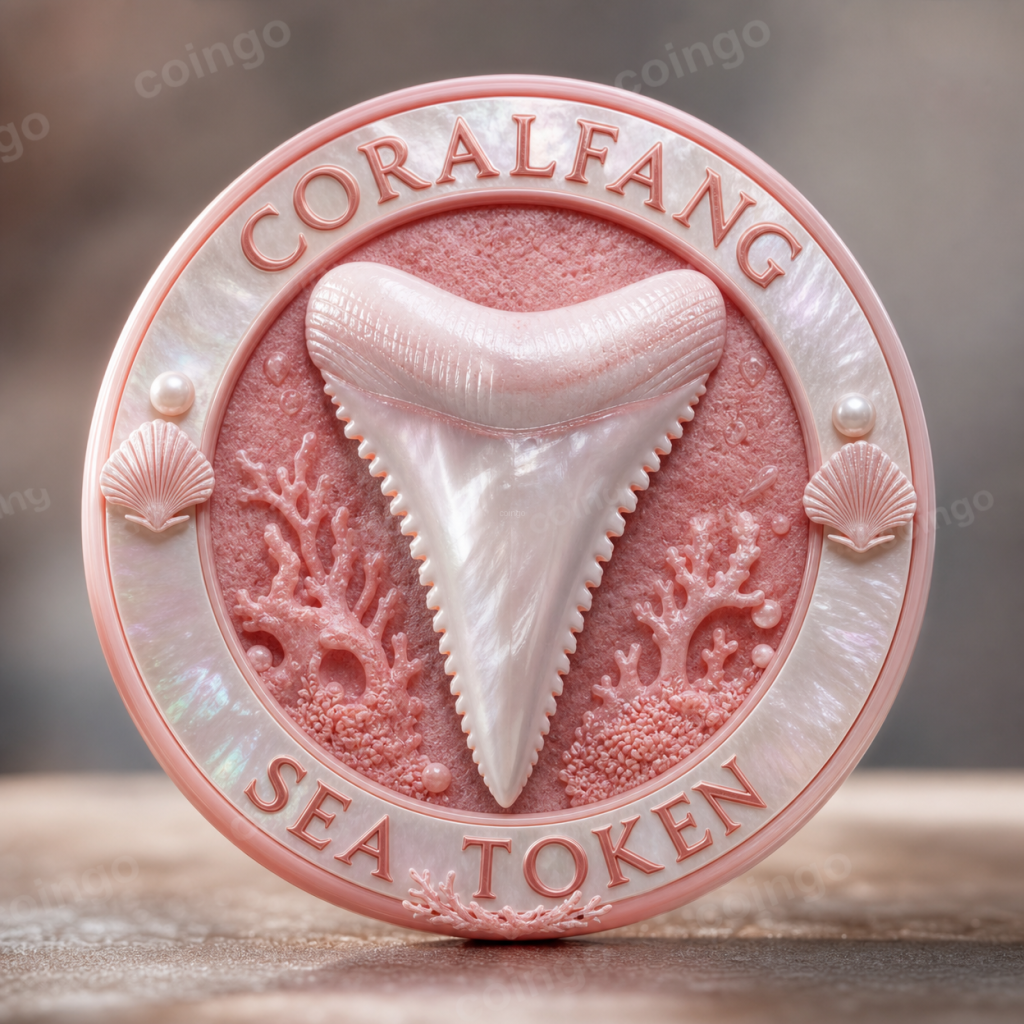
The Coralfang Sea Token’s coral-bronze composite gives it a surface texture unlike any other coin in the collection: slightly irregular, with a subtle organic quality that recalls its material’s coastal origins while demonstrating the precision processing that transformed raw coral material into a mint-quality coinage medium. The obverse displays the Brotherhood’s ouroboros symbol — a sea serpent biting its own tail, rendered with individual scale detail — representing the circular self-sufficiency and perpetual renewal that the Brotherhood aspired to embody.
The reverse carries a map fragment rendered in abstract geometric lines that appear decorative to uninformed observers but function as encoded navigation information for members trained in the Brotherhood’s cartographic cipher. Different Token specimens carry different map fragments, meaning that only individuals with access to multiple tokens and knowledge of the cipher could reconstruct the full network map. This deliberate information fragmentation was a security measure sophisticated enough to defeat several maritime authority investigations into the Brotherhood’s safe harbor locations during the network’s operational period.
Rarity and Collector Value
The Coralfang Sea Token offers collectors a tactile experience unlike any other piece in the collection: the coral-bronze composite’s slightly organic surface texture is immediately distinguishable from the smooth surfaces of metal coins, and its weight is slightly lighter than its dimensions suggest, the coral component reducing density relative to pure metal.
Our reproduction uses a modern coral-composite material that replicates the original’s surface character and weight profile. Each reproduction is individually examined to verify that the ouroboros scale detail and the map-fragment encoding are fully legible, with a cipher reference card included to allow collectors to identify which section of the Brotherhood’s network map their specific specimen carries.
The Legend Behind the Coin
The most widely documented legend of the Coralfang Sea Token concerns what happened to the network when the Brotherhood’s leaders were eventually captured by a coalition of the maritime powers they had been circumventing for over a century. According to accounts from that period, the Token network did not collapse with the leadership’s arrest but continued operating through its distributed structure, the safe harbors remaining functional and the exchange value of Tokens persisting in coastal markets because the network infrastructure itself — the hundreds of harbor relationships, the shared intelligence channels, the mutual aid commitments — was not contained in any leadership structure that could be arrested.
The Brotherhood’s leaders were executed, but the Brotherhood’s network continued, maintained by its members operating the compact’s original terms without central coordination. The Coralfang Sea Token is thus a legend of institutional resilience: a network that outlived its founders because they had designed it from the beginning to need no particular person to keep it alive.
Legacy of the Brotherhood Model
The Coralfang Brotherhood’s organizational model, built around distributed network infrastructure rather than centralized authority, proved more durable than any of the maritime powers that periodically attempted to suppress it. Maritime trading communities along the Brotherhood’s historical route network maintained modified versions of the original compact for generations after the Brotherhood’s formal dissolution, the safe harbor relationships and mutual aid commitments persisting long after their origin in the Brotherhood’s explicit organizational structure was forgotten by most participants.
Historians studying the commercial networks of the post-Brotherhood era have identified what they describe as a commercial immune memory in these communities: an instinctive preference for distributed commercial relationships and mutual aid arrangements over dependence on single dominant authorities, reflecting the two-century experience of living within a network that had made distributed resilience its primary design principle. The Coralfang Sea Token, as the material symbol of that design principle, carries this legacy in every specimen that survives from the Brotherhood’s operational period.
Add This Coin to Your Collection
The Coralfang Sea Token is for collectors fascinated by the intersection of numismatics, network theory, and the history of commercial self-organization. Its coral-bronze texture, its encoded map fragment, its ouroboros symbol, and its century-long history as the key to the ancient world’s most resilient alternative maritime network make it one of the most intellectually distinctive acquisitions in the collection. Order today and receive the network key that coastal traders used to access an invisible commercial infrastructure that defied multiple maritime powers for over a hundred years. Examine the map fragment on your specimen. You hold a piece of a distributed atlas that no single authority ever assembled.
